



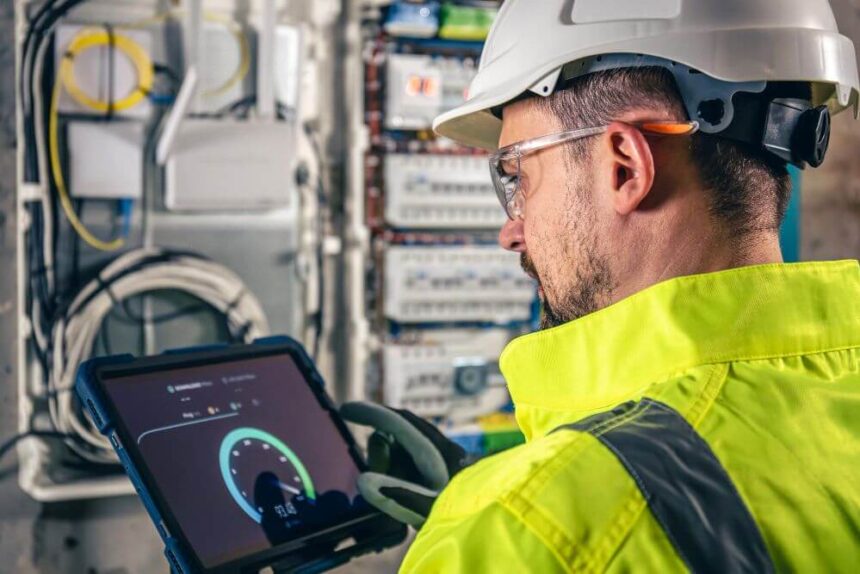
For industries where safety and reliability cannot be compromised at any cost, it is undeniably a matter of primary importance to accurately locate defects in materials and components. Traditional inspection methods typically entail destruction of the tested item, which is not only expensive but also inconvenient. NDT testing provides that defect detection can be done perfectly without any damage, thus maintaining efficiency as well as safety. This article delves into the scientific basis of this method and how it is used to keep materials and structures in good working order without compromising their original condition.
What is NDT Testing?
Non-destructive testing (NDT) comprises a variety of methods for investigating materials, components, or structures to identify any flaws, discontinuities, or irregularities without affecting their usability. On the contrary to destructive testing that can damage or even destroy the material, NDT allows the object to remain intact while revealing its condition.
DMR testing is a very powerful tool in the arsenal of different industries, aerospace, production, construction, and energy to name a few, where safety and reliability are of utmost importance. It is a prevention of faults, a prolongation of the life of the equipment, and a lowering of the maintenance expenses, all rolled into one.
Key Techniques in NDT Testing
Different methods are included in the category of ndt testing depending on the type of materials and the purpose of inspection. The main methods are:
1. Ultrasonic Testing (UT)
Ultrasonic testing is a process of sending sound waves with a very high frequency into the material. These waves will bounce back and be detected by sensors when they find a flaw. By measuring the time it takes for the returned echoes, inspectors can locate the cracks or cavities and judge their size. This technique is very effective for metals, composite materials, and weld inspection.
2. Radiographic Testing (RT)
Radiographic testing operates by means of X-rays or gamma rays penetrating the material. The defected areas such as cracks, voids, or inclusions will absorb radiation differently thus resulting in a contrast being formed on the film or digital detectors. RT is an excellent method for examining welds, pipelines, and castings.
3. Magnetic Particle Testing (MT)
Magnetic particle testing can be considered a perfect method for locating cracks and other surface defects in ferromagnetic metals. During the test, the metal is first magnetized and then ferrous particles are dusted over it. Cracks or other discontinuities which are present in the metal will cause the ferrous particles to cluster at that spot or become visible.
4. Liquid Penetrant Testing (PT)
Liquid penetrant testing is a very simple method which produces quite good results in locating surface defects. A kind of dye is poured over a metal surface to help give the dye more time to penetrate the cracks. Next, the dye is wiped off and a developer is applied which makes the dye come through the cracks and thus the defects become visible to a human eye.
5. Eddy Current Testing (ECT)
In the eddy current testing method, electromagnetic induction is used for the detection of flaws in conductive materials. A coil in the probe is energized by an alternating current that produces magnetic fields which, in turn, create eddy currents on the surface of the material being inspected. The intensity of those currents changes when the eddy currents are disrupted by defects, allowing the inspector to locate them.
Advantages of NDT Testing
Comparing to the old inspection methods, NDT testing has a lot of advantages:
- Non-invasive: Inspections are carried out on components without any dismantling and the parts are left fully operational.
- Cost-effective: It helps to save money by stopping needless replacement of parts and lowering the loss of production time.
- Safety: Identifying defects at an initial stage reduces the risk of injuries and major accidents.
- Versatile: It can be used on different materials and shapes of various constructions.
- Reliable Data: It helps to get both, qualitative as well as quantitative data of the material’s condition.
Applications Across Industries
Since NDT testing is so useful, it has become a must-have tool for many industries including:
- Aerospace: Checks that the components of an aircraft are safe to be used over a very long period, as well as to understand the aftereffects of any failures.
- Oil and Gas: Inspects pipelines, tanks, and platforms so that leaks or explosions can be avoided.
- Manufacturing: Controls the quality of metals, plastics, and composites coming out of the production line.
- Construction: Keeps a check on the lifespan of key infrastructures like bridges and skyscrapers.
- Energy: Inspects turbines, generators, and power plants to identify defects that can hinder operational activities.
The Future of NDT Testing
Technological advancements are constantly pushing the limits of ndt testing capabilities. Thanks to digital imaging, automated scanning systems, and AI-powered analyses, it is now possible to detect defects more quickly and accurately than ever before. Not only do these innovations improve safety, but they also shorten inspection times, thus leading to greater efficiency and reliability in industries.
Non-destructive testing will always be a pillar of quality control and safety as the industrial sector is expanded, making sure that materials and parts can be trusted to do their job. By accurately and promptly identifying defects, non-destructive testing facilitates engineers and operators in optimizing equipment usage, thereby enhancing safety standards and reducing costs.
Final Words
To sum up, ndt testing is a critical instrument in any industry where there is a need for high precision, utmost safety, and unmatched reliability. It does not just help save the layer of materials and their components, but it is also instrumental in preventing disastrous failures and accidents by identifying hidden flaws. Non-destructive testing is expected to dominate the industry further in the coming years backed by technology, which is vital in controlling quality and safety, raising the life cycle of equipment, and facilitating a smooth running production. Harnessing the potential of this science is equivalent to making wise choices that safeguard both human beings and assets.
